
If you’re anything like me, you come up with ideas all the time. In fact, your ideas give birth to other ideas, and then other ideas, until your brain is filled with so many ideas that it paralyzes you from even starting the next thing. The only escape from this overwhelming cycle seems to be sleep. Today, we are going to talk about Ideation Versus Execution and borrow some ideas from the agile approach to project and product management.
Let’s go to class:
There are a lot of project management methodologies, but for the sake of this blog, we will focus on the traditional project management approach and the agile methodology. Traditional project management often involves extensive planning and a rigid, linear process that can take a long time to complete. This approach typically includes distinct phases such as initiation, planning, execution, monitoring & controlling, and closure. Each phase must be completed before moving on to the next, which can make it difficult to accommodate changes once the project is underway.
Agile, on the other hand, emphasizes flexibility, continuous improvement, and the ability to adapt to changes quickly. Instead of following a linear process, Agile uses an iterative approach where work is divided into small, manageable cycles called sprints. Each sprint aims to produce a potentially minimum viable product and/or shippable product increment, allowing for regular feedback and adjustments. Agile methodologies encourage close collaboration between cross-functional teams and stakeholders, fostering an environment where change is expected and welcomed as a part of the process. This iterative nature not only enhances the ability to respond to new information and changes but also promotes continuous improvement throughout the project lifecycle.
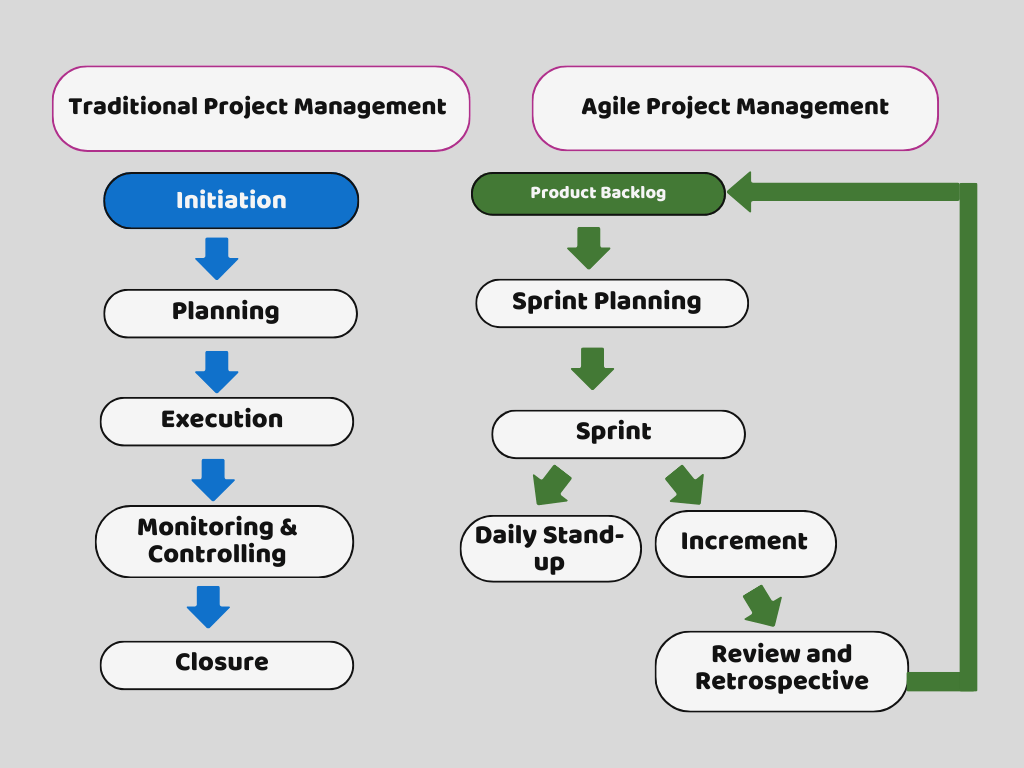
In the context of ideation versus execution, the principles of agile methodology can be incredibly beneficial. By simplifying our ideas and focusing on producing a minimum viable product (MVP), we can transform overwhelming concepts into actionable steps. Just like in Agile, starting with an MVP allows us to test, learn, and iterate based on feedback, rather than getting stuck in the endless cycle of ideation. This approach encourages us to take the first step, no matter how small, and build from there.
For instance, I considered a platform to share my thoughts and ideas. My first thought was YouTube because most people like to watch videos. However, as soon as I delved into the idea, my inner dialogue began to spiral. First, I had to decide on the approach I wanted to take and how to differentiate myself. Should I opt for a documentary-style presentation or a commentary style? Should I conduct interviews or go solo? Next, I pondered over the gear I would need. What is the easiest equipment to start with, what are the best angles, what kind of lighting should I use? Then there was the editing aspect—how would I edit those videos?
With a high dose of perfectionism and these countless considerations, I found myself stuck in the ideation phase, overwhelmed and unable to start. This is when I decided to step back and reassess my goals. What I truly wanted was a platform to share my thoughts and ideas, and I realized I could do this much more simply by starting a blog. This decision to start a blog represented my minimum viable product (MVP)—a way to begin sharing my ideas without the paralysis induced by overthinking every detail.
By choosing to start small, I was able to bypass the overwhelming intricacies and focus on the core objective: sharing my thoughts. Through blogging, I am forming habits and learning valuable lessons about content creation, consistency, and audience engagement. These experiences are invaluable and would serve as a solid foundation should I decide to venture into the more complex world of YouTube in the future.
In essence, adopting an MVP approach allowed me to move from ideation to execution, providing a tangible platform for my ideas and setting the stage for future growth and exploration. This process highlights the importance of starting small, learning, and iterating—a principle at the heart of Agile methodology.
In conclusion, while ideation is an exciting and crucial part of the creative process, execution is what brings ideas to life. By adopting agile principles, we can simplify our approach, start small, and continuously improve. This shift from ideation to execution can transform our endless streams of ideas into tangible, impactful results.
 T.M. Kayode
Leave a comment