
In this blog post, we’ll explain how the Times Higher Education (THE) Impact Ranking works and how to submit for it. This is the first in a new series. In future posts, we’ll cover the THE World University Ranking and the THE Sub-Saharan Africa Ranking.
History of the THE Impact Rankings
The THE Impact Rankings started in 2019 with submissions from 450 universities across 76 countries. By 2024, this number had grown to 2,152 universities from 125 countries. The rankings measure how universities help achieve the UN’s Sustainable Development Goals (SDGs). There are 17 SDGs, and universities send in data to show their impact on these goals. THE then uses this data to score and rank the universities based on their efforts in sustainability and social impact.
Criteria for Getting Ranked
Unlike the THE World University Ranking, which needs at least 1,000 published articles, the THE Impact Rankings have different requirements. Here’s what you need to do to get ranked:
- Register for Free: Sign up on the THE website for new universities.
- Eligible Universities: Any university that offers undergraduate or postgraduate courses can submit data.
- Other Institutions: Institutions outside this group that research the SDGs can also submit data e.g. research institutes.
- Submission Timeline: The submission portal opens in September and closes in November. For the 2025 ranking, the portal opens on September 16, 2024, and closes on November 11, 2024.
- Data Requirements: Universities must provide data on SDG 17 and at least three other SDGs to be included in the overall ranking.
How the Ranking is Evaluated
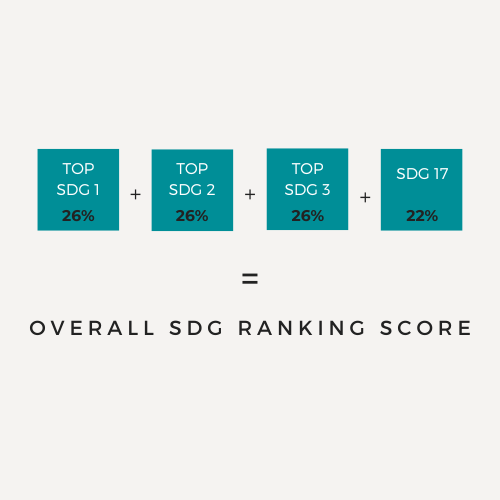
The ranking looks at how universities meet the 17 Sustainable Development Goals (SDGs). For each SDG, universities are evaluated on research, stewardship, outreach, and teaching. Each SDG has specific questions that universities must answer. The results from SDG 17 and the top three other SDGs are combined for the overall score. The top three SDGs each have a weight of 26%, while SDG 17 has a weight of 22%. The total of these weights gives the final score.
Different Types of Evidence Required
When submitting data to the ranking, universities need to provide different evidence. There are two main types:
Evidence Collected from Elsevier
- This includes publication-related data, such as the number of publications in each sdg and the number of publications in top journals.
Evidence Collected from the University
- Continuous Data: Universities must provide data on the number of students, faculty, and staff.
- Policy and Initiative Documents: This includes evidence of policies and initiatives, like mentoring programs.
- Sustainability Report: Universities need to publish a sustainability report, which is important for each SDG, especially SDG 17.
How to Present Your Data
You can provide evidence that is public or private, but it’s best to make it public to get the highest score. At Tmkayode Consulting, we recommend that universities have a dedicated portal for the SDGs or the ranking to organize all the evidence.
At Tmkayode Consulting, we believe the Impact ranking is one of the easiest ways to get your University noticed globally. The ranking criteria also help Universities position themselves as leaders in various research areas where they have also made significant societal contributions.
If you would like an unbiased assessment of your University’s readiness and positioning for the Impact rankings. Send us an email using the contact form below.
You can find a detailed overview of the ranking here: THE Impact Rankings 2024 Methodology.
See you in the next post.


 T.M. Kayode
Leave a comment