

When I thought of the idea for this blog post, my instinct was to create a plot that would map out my perceived impression of my productivity from when I was ten years old until today. I had a rough idea of what it would look like, but I believed that this visualization would help drive home my point. Productivity is a dynamic concept, constantly evolving with the various stages of our lives. Reflecting on my journey, from the carefree days of singlehood, through the early years of marriage, and into the demanding yet rewarding era of raising children, I have come to understand that productivity is not a one-size-fits-all measure. Instead, it is a fluid, adaptable aspect of life that changes as our responsibilities and priorities shift. In this post, I will share what productivity looks like in my new parenting era, offering insights and tips for fellow parents striving to balance it all.
Before we look at the insights, let’s take a look at the graph:
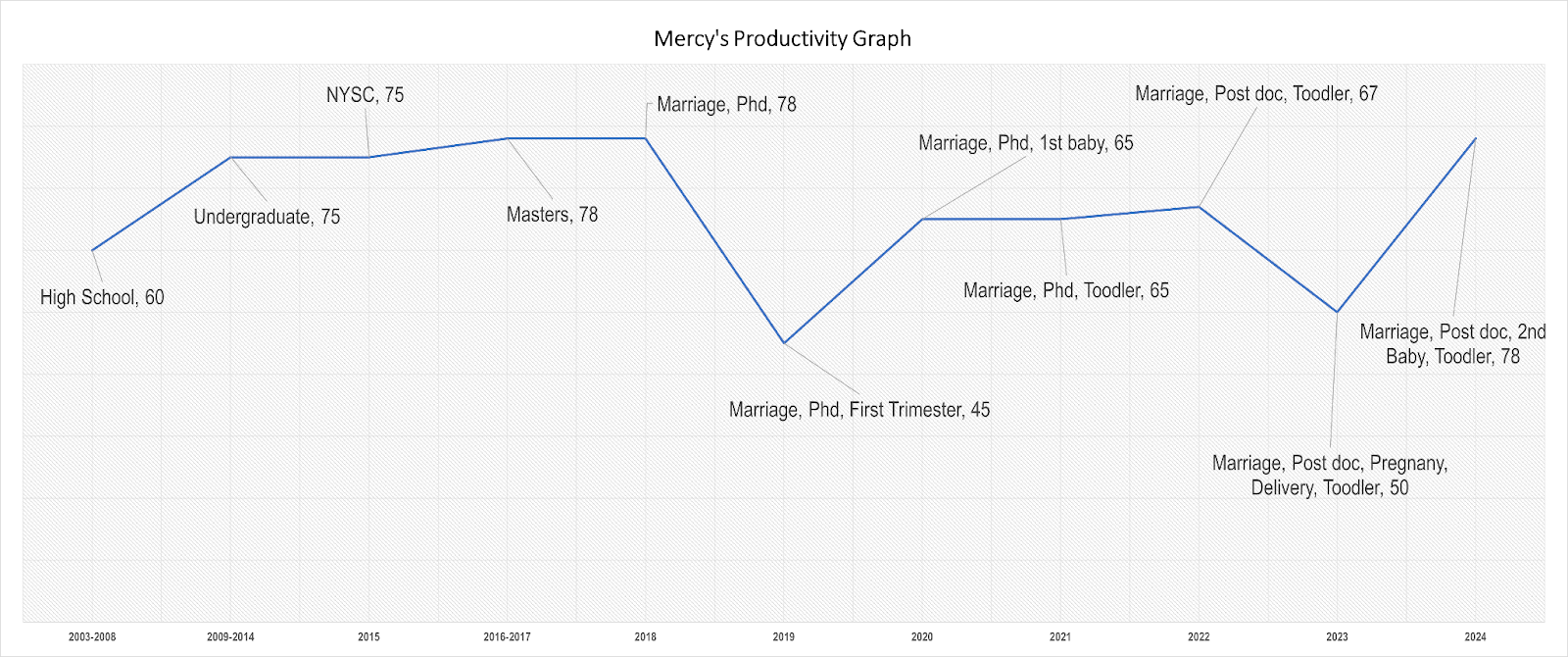
Figure 1: Mercy’s Productivity Graph
In the graph titled “Mercy’s Productivity Graph,” you can observe the evolution of my productivity over the years, marked by significant life events. The timeline begins in high school, with a steady rise from a score of 60 in 2003 to 75 in 2008. The trend continues into my undergraduate years (2009-2014), with a notable peak at 85 in 2014, showcasing a period of high productivity. Afterward, during my NYSC year in 2015, productivity slightly dips to 75 but remains relatively stable through my Master’s degree (2016-2017) at 78. In 2018, as I embarked on marriage and a PhD, my productivity maintained a steady score of 78. However, a significant drop to 45 in 2019 reflects the challenging phase of the first trimester of pregnancy (this one its own is a long blog post). The graph then shows a gradual recovery, reaching 65 in 2020 with the birth of my first child, and maintaining stability through the toddler years. Despite a slight dip to 50 in 2023 due to the added pressures of a postdoc, pregnancy, delivery, and a toddler, my productivity rebounded sharply to 78 in mid 2024 even with the arrival of a second baby. This visual journey underscores the dynamic nature of productivity, influenced by the varying demands and milestones of life.
Now my insights:
A. Prioritize Tasks and Set Realistic Goals
Maintaining productivity involves a delicate balance of task management and goal setting, which varies significantly depending on your life stage—whether you are single, married, or a parent. As a single person, you can focus intensely on personal and professional development, setting ambitious goals and prioritizing tasks based on deadlines and growth opportunities. Do as much as you can now, learn all you want, and build capacity, as this will serve you well in the future—I cannot begin to tell you how the benefits of the things I learned and explored during my undergraduate and master’s years continue to serve me to this day. In marriage, task management becomes a joint effort, requiring coordination and communication to align both partners’ schedules and shared objectives, such as saving for a house or planning vacations. As a parent, the focus shifts towards family needs, and setting realistic goals becomes crucial due to limited time and energy. This involves prioritizing the most critical tasks, delegating when possible, and being flexible to adapt to the unpredictable nature of parenting. Regardless of the stage, the essence of productivity lies in understanding your capacity and setting attainable goals, ensuring a balanced and fulfilling life. Productivity looks different at each stage of life, and it is important to embrace the stage you are in. As a married or parenting person, don’t spend time longing for the “freedom” you had when you were single to the point that you lose sight of the awesomeness in your present. Productivity looks different at every stage. Embrace it.
B. Create and Stick to a Schedule
Creating and adhering to a schedule is a cornerstone of productivity, tailored differently for singles, married individuals, and parents. As a single person, your schedule can be highly flexible, allowing you to dedicate uninterrupted blocks of time to your studies, career, hobbies, and social activities. This is the perfect time to experiment with different time management strategies to discover what works best for you, laying a strong foundation for future productivity. Tools like to-do lists, diaries, and digital calendars can help you organize your tasks and commitments effectively.
For married individuals, a schedule becomes a vital tool for coordinating with your partner, balancing personal and shared responsibilities, and ensuring that both of you have time to pursue individual interests and joint activities. Regular planning sessions can help you stay aligned and prevent conflicts. Utilizing shared digital calendars (like Google Calendar), task management apps (like Todoist or Trello), and traditional planners can facilitate smooth communication and coordination.
For parents, a well-structured schedule is essential to manage the myriad tasks that come with raising children, from school runs and extracurricular activities to household chores and work commitments. Flexibility within your schedule is key to adapting to the unpredictability of family life. Tools such as family calendars, meal planning apps (like Mealime or Plan to Eat), and routine trackers (like Cozi or Chore Pad) can be incredibly helpful. Establishing a routine that includes designated time for self-care and family bonding can help maintain balance and reduce stress. Regardless of your life stage, sticking to a schedule can help you stay organized, focused, and productive.
C. Embrace Imperfection and Practice Self-Compassion
Embracing imperfection and practicing self-compassion takes on unique dimensions from various life perspectives. For a single individual, it entails acknowledging that you are enough just as you are, without needing external validation. It involves understanding that mistakes are a natural part of growth and learning, and treating yourself with kindness and understanding.
In marriage, it means accepting both one’s own and one’s partner’s flaws, fostering a supportive and forgiving environment where growth can flourish. Parenthood magnifies the need for self-compassion, as it involves constant juggling and inevitable mistakes. Recognizing that perfection is unattainable allows you to be more present and nurturing towards your children. Ultimately, embracing imperfection and practicing self-compassion enriches every facet of life, fostering resilience, empathy, and authenticity.
D. Invest in Self-Care and Well-Being
Investing in self-care and well-being holds varying significance across different life stages and roles. For a single individual, it involves prioritizing personal health and happiness amidst the demands of work and social life. This could mean setting aside time for relaxation, pursuing hobbies, and nurturing meaningful relationships. In marriage, self-care extends to both partners, emphasizing the importance of supporting each other’s physical and emotional needs. Communication and mutual respect play key roles in maintaining a healthy balance between individual and shared well-being. Parenthood adds another layer of complexity, as a parent you must navigate your own needs alongside those of your children. It entails finding moments for self-renewal, whether through brief moments of solitude, exercise, or seeking support from loved ones. Actively simplifying life’s complexities is vital across all these contexts, whether by delegating tasks, establishing routines, or reassessing priorities. By investing in self-care and well-being, individuals can cultivate resilience and create a foundation for a fulfilling life journey.
E. Communicate Openly with Your Partner and Children
Open communication is the cornerstone of healthy relationships within families, fostering understanding, trust, and connection. For partners, openly sharing thoughts, feelings, and concerns cultivates empathy and strengthens the bond. It involves active listening, expressing emotions constructively, and resolving conflicts with respect and compromise. In the parent-child dynamic, communication lays the groundwork for a supportive and nurturing environment. It’s essential for you to create a space where your children feel safe to express themselves, ask questions, and share their experiences. Open communication encourages honesty, builds resilience, and fosters a sense of belonging within the family unit. By prioritizing transparent dialogue, families can navigate challenges together, celebrate successes, and grow closer, forming lasting bonds built on mutual respect and understanding.
 T.M. Kayode
Leave a reply to abikemary126 Cancel reply