
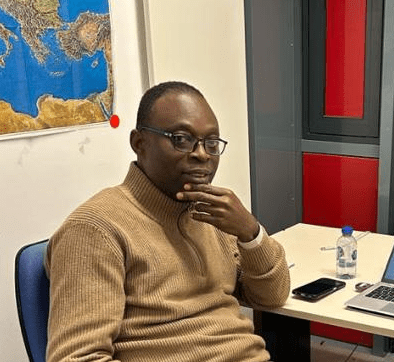
I started feeling something was wrong when I sent you a message on March 20th and didn’t get a reply.
Of course, I didn’t want to make a mountain out of a molehill. From our last conversation, I could sense that you were tired, so I figured you just needed some time to rest. I had a few updates to share from the committee we were working on, and I thought I’d wait a bit before following up.
But then a few more days passed. More updates came. Still no response.
I began to worry.
Because even though you were a professor of the highest calibre, you were always accessible. Even with your health challenges, you continued to show up—present, supportive, dependable—for the people, groups, and causes that mattered to you.
I only had the privilege of knowing you for a few months, Sir, but it didn’t take long to understand the kind of person you were.
Different. In the best way.
It’s taken me a while to come to terms with your passing. I’ve tried and failed every day to not think about it. But maybe that’s a good thing. Because every day I’m reminded of your grit, your tenacity, and the way you lived—fully and sacrificially, until the very end.
So I decided to honor you the best way I know how: through writing, through research, through remembering.
Proooooooooofffffffffffff.
You really tried.
In just 50 years, you accomplished what many would not manage in 90—and no, that’s not an exaggeration. You lived deeply, generously, and purposefully. And I believe you emptied yourself completely.
I wasn’t surprised to learn from the many tributes pouring in that you were once the Bible Study Secretary and later the President of your fellowship in university. You always gave off those nurturing “Papa” vibes. You led with a rare brand of integrity—no half-measures, no shortcuts.
Our meeting was what I would call a kairos moment—one that shifted the trajectory of my life.
I had an idea. A wildly ambitious one. I was thinking about how we could transform higher education in Nigeria and across Africa and I wanted to work with trailblazing Universities in Nigeria. It felt like a long shot, but I obeyed the nudge from God and submitted my proposal to you. You were Director of Academic Planning and Quality Assurance at Redeemer’s University, and I figured if anyone could understand the vision, it might be you. Still, I didn’t expect much.
To my surprise, you responded within 24 hours.
(Most Nigerian Professors don’t do that.)
You not only responded—you agreed to meet on Zoom, and when we met, you listened. Intently. Kindly. You asked thoughtful, progressive questions. You cared. You were curious. And you were deeply invested in progress—real, measurable progress for your institution and for African education.
And then—just like that—you gave my ideas a chance.
We worked together. We implemented and executed the project on schedule. It still feels surreal.
In our institutional assessment, we discovered you had consistently ranked among the top 10 researchers at Redeemer’s University every year since 2014. And perhaps even more impressive—so had your wife, Professor Foluke Olayinka Unuabonah.
Yes. A real academic power couple.
I remember telling you both were on the top list and calling you “The Unuabonahs: Power Couple Edition.” You chuckled, brushing off the attention like you always did.
And in case anyone is wondering—no, this wasn’t some case of gift authorship. You were a Professor of Chemistry. She’s a Professor of English. Two vastly different fields. What you shared was not a CV—it was a deep commitment to excellence.
Let me nerd out a little and try to explain what Prof actually worked on—just in case you’re curious.
Prof spent his career helping people access clean, affordable water. But not in some lofty, theoretical way—he actually figured out how to use local, natural materials like kaolinite clay, plant fibers, and charcoal from crops to clean up dirty water. That’s huge. These mixtures—called composite materials—were designed to trap all sorts of harmful stuff: heavy metals, dyes from textile factories, leftover medications, even bacteria. And the beauty of it? It’s low-cost and doesn’t leave behind new pollutants.
He was especially excited about using sunlight—good ol’ African sunlight—to power a process called photocatalysis. That’s when light helps trigger reactions to break down nasty things in water. Prof showed that with the right tweaks—like adding zinc oxide—these clay composites could take out even tricky chemicals like painkillers and hormones, which are hard to remove and can affect both humans and animals long-term.
And he didn’t stop there.
He also studied how antibiotics end up in rivers and what that means for us. (Spoiler alert: it’s not good.) When antibiotics linger in our water, bacteria can start evolving resistance. That means our meds stop working. Prof’s research helped map how serious this issue is—especially in Nigerian cities—and offered solutions to clean up that water using, again, local, sustainable materials.
What I love the most, though, is this: his entire career was a love letter to African science. He wanted Africans to solve African problems using African resources. He believed the answers weren’t “out there,” but already within our grasp—if only we’d look closer, collaborate better, and believe more. He championed this as the first-ever president of the Nigerian Young Academy, mentoring early-career researchers and making room for more voices at the table.
And the way he mentored? Whew. No ego. No politics. Just presence. Just support.
Many of his PhD students are now thriving globally—not because he pushed them out the door, but because he pulled them up. He gave them tools, gave them space, and let them shine. That’s not luck. That’s legacy.
You may no longer be here in the physical sense, but you’ve left your fingerprints on so many lives. Bits and pieces of your wisdom, your laughter, your humility, your fire—they live on in all of us.
Now, it’s our turn.
Our turn to take the mantle.
To continue the work.
To dream big, like you did.
To build deeply, like you did.
To serve relentlessly, like you did.
Prof, we miss you. Deeply.
But we haven’t forgotten.
And we won’t.
We’ll keep your name alive – in the classrooms, in the labs, in the boardrooms, and in the quiet moments of deep thinking.
And as for me, I’ll keep writing. I’ll keep working. I’ll keep dreaming wildly in your honor. Because somehow, that feels like the most fitting way to say goodbye…
…without really saying goodbye.
Until we surely meet again at the Lord’s Bosom.
 T.M. Kayode
Leave a reply to deborahadesina Cancel reply